The Dwaijn is an animal that originates from Dernian Landis (Myrëns). The first Dwaijn came to Daleth in 1823. It was a gift from the Dernianen Queen to the Emperor of Daleth. The Emperor kept the Dwaijn in the Imperial Zoo in Ildritz, where his other living presents are showed as well. Some less diplomatic members of the Court said there was no Dwaijn at all, but the Imperial Guard set things right and ever since, no offensive things have been said about the Dwaijn again.
The Dwaijn bore children in the Zoo and these Dwaijns can be seen on many a Foor. For only half a Kintus one can look into the cage and watch this miracle of nature. How the Dwaijn got her children is still a mystery, but it is supposed the gift was a pregnant female, and her children mated and formed the Dalethian population. This population consists of about a dozen Dwaijns - some have been exported to Luban and Fanigawi.
Scientists from the University of Ildritz (Faculty of Animals and Life-Science) think the Dwaijn might be a being that lives in multiple dimensions at the same time and it's Bisitheins does not have the same rhythm as other animals. This might explain most if not all, and makes the gift from Dernian Landis even more amazing.
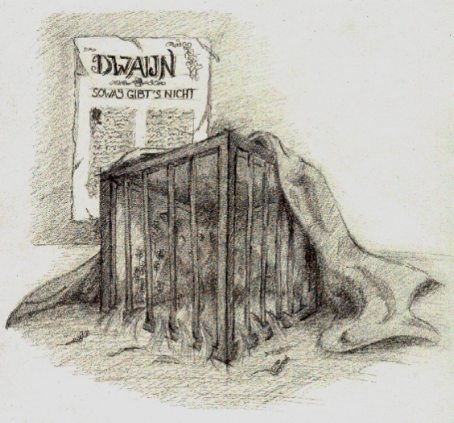
Don't feed the animals - don't let the animal out of the cage!
Never seen anything like it
According to the Dernian Queen, the Dwaijns live in the highlands of Myrëns (Zhënmel), and in the Singing Woods (Chëntopiil). It is shy and keeps away from humans. It can't be petted, but isn't aggressive either. It is fed with fresh grasses and the leaves of the Green Jusila. These should be places in the cage in the evening, so the Dwaijn can drink the dew from them in the morning. The animal needs the leaves to hide itself from the public as well, without some privacy the Dwaijn dies. It eats other things that are put in the cage as well, like silver coins and golden rings.
Das Dwaijn (einheimisch: Dwÿn) (offiziel: Dernianeins Dwaijna ph.)
Nicht futtern - das Tier nicht aus dem Käfig heraus lassen!
Sowas gibt's doch nicht?
Herkunftswelt: Daleth
Herkunftsland: Dernian Landis (Myrëns)
Art des Tieres: Multidimensionstier
Lebensraum: die Hochlaender (Zhënmel), sowie das Singende Wald (Chëntopiil). Wie es dort lebt, ist bis jetzt unbekannt, da Dernian Landis immer noch Sperrgebiet ist, und es keine wissenschaftliche Beschreibungen aus diesem Land gibt.
Verhalten: Das Dwaijn ist sehr scheu und lässt sich nicht streicheln. Es ist aber sicher nicht aggresiv oder bissig.
Aussehen: s. Bild.
Futter: frisches Grass und Blätter der Grüne Jüsila am Abend im Käfig tun, morgens trinkt das Dwaijn der Tau davon. Während den Tag ißt es Grass und knabbert an die Blätter. Das Grünzeug braucht es auch zum runterschlafen - ohne Schütz seiner Privacy stirbt das Tier. Gelegentlich ißt es auch andere Sachen, die man im Käfig hinterlasst, wie Münze und goldene Ringe.
Das erste Dwaijn kam in 1823 nach Daleth. Es war ein Geschenk der Dernianer Fürstin an der Kaiser von Daleth. Der Kaiser bewahrte das Dwaijn auf in den Reichszoo in Ildritz, wo auch seine andere tierische Geschenken zu bewundern sind. Einige wenig diplomatische Hofsmitglieder behaupteten, es gab gar kein Dwaijn. Der Kaiserliche Garde haben diese unhöffliche Ideen schnell geaendert, und seitdem ist das wertvolle Geschenk nur noch von den Dalethianern geacht worden.
Im Zoo hat dieses Tier sich vermehrt und seine Nachkommen sind auf manche Foor zu sehen - nur für ein halber Kintus darf man beim Käfig kommen um dieses Wunder der Natur an zu glotzen. Wie es sich vermehrt hat, ist bis jetzt unklar. Wahrscheinlich war das ursprungliche Geschenk ein schwangeres Weibchen, und die Nachkommen haben sich dann später gepaart. Jetzt gibt es in Daleth etwa ein dutzend Dwaijns. Einzelne Dwaijns sind nach Luban und Fanigawi exportiert worden.
Kaiserliche Wissenschaftler der Ildritzer Universität (Fakultät der Tierkunde und Lebenswissenschaften) denken, das Dwaijns ist ein Multidimensionstier, dessen Bisitheins ein anderes Rhythmus haben als normale Tiere. Das würde vieles erklären und macht das Geschenk aus Dernian Landis noch viel einzigartiger.
Related topics: