The Region
The White Mountains are a mountain range dividing Daleth from north to south in east (De Erflanden) and west (De Weslanan). They begin way up north, in Gi-Albter, where they are only hesitating hills. Then they gather around Het Koude Dal in an abundance of valleys, canyons and cliffs, to reach out to heights beyond the snow border - the tops of the mountains here are also in summer covered in snow. Further south, they are lower, but still high enough to form a barrier between west- and east Daleth. In the south, they collide with the Black Mountains at Gronbrunlar.The light colour of the rocks gave the mountains their name. Chalk stone is the main ingredient of the rough mountains, weathered by rain and wind, and the harsh winters of Daleth. The valleys are narrow and deep, rocks of all sizes have bizarre shapes. The slopes are at many places bare, but on others overgrown with dark fir woods, birks, and thorny bushes.
At the feet of the mountains, many clear wells are found. Both the Noorderstroom River and the Cold Cin have their source in the White Mountains.
The valleys and canyons provide access to the inner mountains, to veins? of gemstones and silver. In Ciniz and near Unvar, there are silver mines, Gronbrunlar is the place where most gemstones can be found.
The erosion of the White Mountains left some very strange shaped valleys where a microclimate can be found. In these places, some rare plants grow, or plants that are normally not found in these regions.
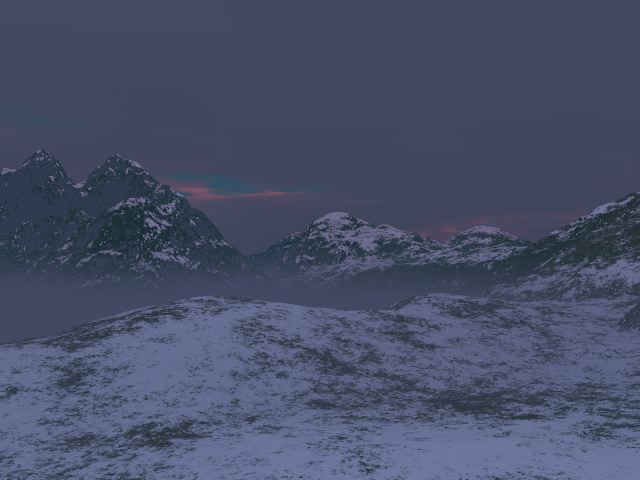
Sunrise in the northern part of the White Mountains
Het Koude Dal
Such microclimates can be found in Het Koude Dal. This very northern valley has been the place where northern Sudzi have lived the last centuries. They could keep up their isolated society, because of the variety of food that was found in the mircoclimated corners of Het Koude Dal.The valley itself is hardly accessible. High in the mountains, it is a kind of green bowl between the highest and barest tops of the White Mountains. Het Koude Dal is full of pine-trees and firs. The climate is so warm, there are also some lorks.
The Tundstains is a common gem here and next to wood the pillar where the economy of Het Koude Dal is leans upon.
Old Oth Road
Halfway the White Mountains, there used to be a road connecting Unvar in the West and Razn'Oth in the east. This road, the Oth Road, is the middle road through the White Mountains, and used the be the most important, for it was Razn'Oth where the old Kings of De Erflanden had their residence. The road brought welfare and wealth to both Unvar and Razn'Oth, even after the Kings of De Erflanden went to Ildritz to establish the Imperial Court there.However, the road turned out to be unsafe. After some landslides and avalanches in the early 14th century, the road became less popular. Freedom fighters of the Weslanan bothered the travellers of the Old Oth Road and sometimes they were robbed, if not killed.
A huge landslide in the 16th century, where a whole mountain slope collapsed and swallowed the road, made an end to the Oth Road. The middle part of the road is no longer accessible, and maintenance for the rest of the road stopped. The citizens of both Unvar and Razn'Oth use the remaining parts to herd their sheep and walk up into the mountains on a nice summer day.
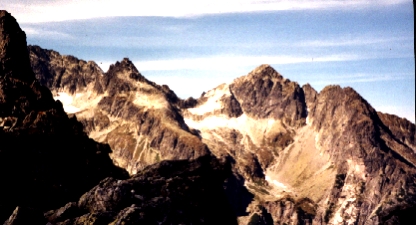 High up in the white mountains, just above De Prinya |
De Prinya
De Prinya is a rough valley in the White Mountains, near Ciniz. It is famous for its hordes of Kamzygs and its beautiful nature. The valley is rather accessible, and not far from Unvar and Ciniz. It has been a place for excursions ever since the first settlements were build.A small cabin is build here, once the home of Valdemar the Mad Hermit, and still a shelter for those who choose the quietness of this place.
Nearby, bizarre rock formations can be found, with fantastic names like "the Hunter", "the Dancing Deer", "Rockfall" and more. One of these stone formations has the form of a building, and is supposed to be a temple of some ancient, forgotten god, although nobody will be able to tell how old that god will be or what culture praised him, or her. The "Ancient Temple" has been used a few times for the Cult of Molik and seems to have been visited and researched by the Keepers of Doravor.
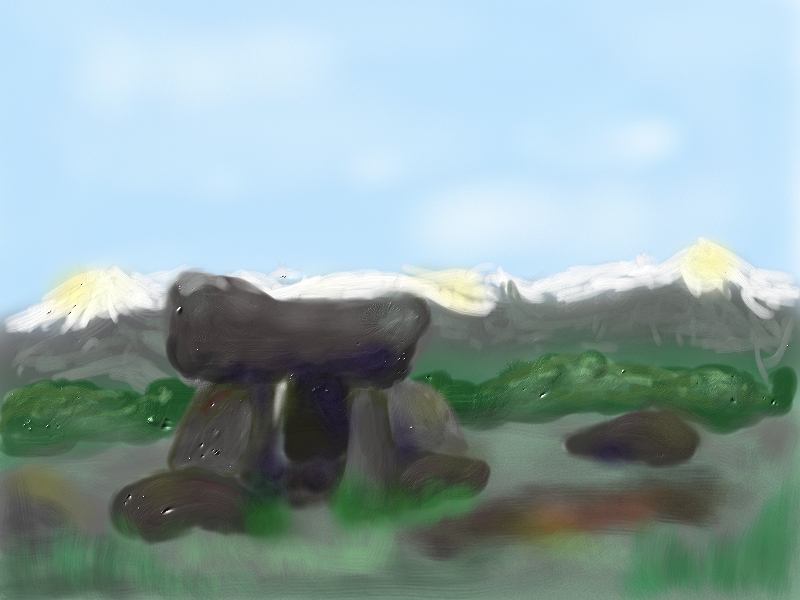
"Temple of Molik"
Pas Ciniz
The most southern route over the White Mountains is the Cinizer Pass. At the western entrance of the pass is an in called "Pas Op" (nickname of the pass itself) or "Vol Bloedt". On the eastern side used to be an inn called "Poort van het Oosten", the doors at the eastern border of Ciniz.The Cinizer Pass is a very dangerous one; the road is narrow and the roadside steep - up and down. The weather can be dangerously changeable up here, high in the White Mountains.
It takes one full day to walk from one inn to the other. Running, this can be much faster. Every year the White Mountain Run is held to see who can walk this track the quickest. Carriages and such cannot go over the pass very fast, there is no room for carriages with more than two horses, and the road is not good enough to speed up. Parts of the road are very steep, and the risk of avalanches is always big. In winter, the Pass might be impassable due to all the snow and ice.
At the end of the 16th century, as the Old Oth Road was blocked, the Cinizer Pass was the terrain where Conrath the Robber worked. The brother of the Count of Ciniz had a way of robbing and charming and getting on the nerves of many passers by. The Cinizer Pass was known as very dangerous in that time, but was the only way from De Erflanden into the Weslanan, unless you wanted to travel via Salamandran and Vîmeir.
Related topics: