| Elfane | 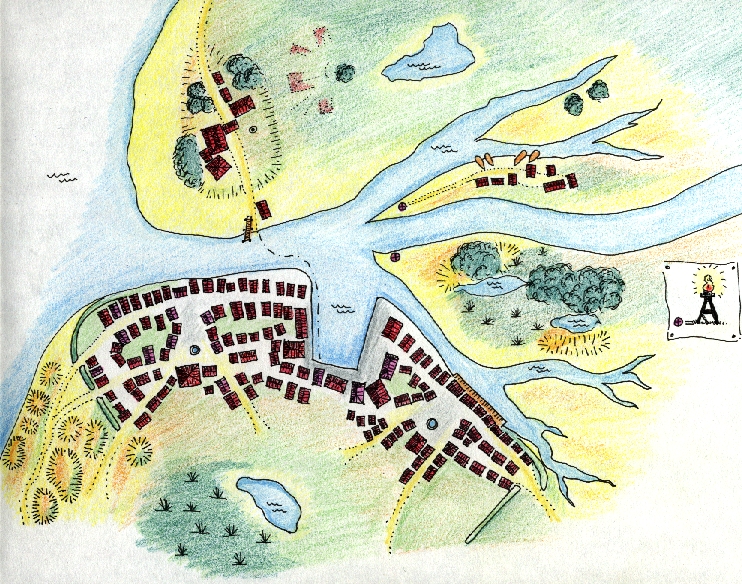
|
|
| Population: | 3000 | |
| Region: | Salamandran (Skaunsric) | |
| Highlights | ||
| Old harbour, Fishermens Village, Castle Old Elfane | ||
| Economics | ||
| Fishing, sheepherding, reed cultivation | ||
The town of Elfane and its harbour are very old. It was already a Naglani settlement in the 5th century, as they made their escape from Trigohaima and settled in Daleth. The original village, east of the Old Castle, is now a ruin in the swamp of the changed river mouth. The town stayed under control of the Naglani until the 12th century. Originally, the harbour was made to build ships and return with them to Trigohaima. As the Naglani liked Daleth, Elfane could also be a port to Trigohaima.
During the Search for Trigohaima, Elfane became a rather large town and the part south of the river was build; also necessary because the Iven river and the creeks had changed their course.
It was for a short period of time the centre of the Naglani world. It had contacts with Uzda and harbours on the Fanigawi coast. The Elfane ships sailed the whole of the Fairhvussaiws - as the Naglani said.
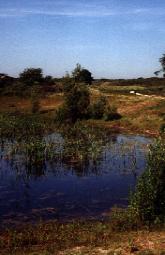 Dunes south of Elfane |
After that, the town suffered from many raidings from Vîmeir pirates, the town became nothing more but a burnt down settlement for the poor and the ill.
The town gained a little in importance in the 15th century. Only recently, the town became vivid again when the rich and noble of Salamandran build their summer dwellings in Elfane and surrounding dunes. The houses can only be dwelt in when the wind does not come from the east - the stench the wind takes with it from the Swamps of Gamoor is too bad to live in.
The oldest settlement is found on the northern bank of the Iven River. The ruins of some traditional Naglani buildings can be found here, in the round form of the Naglani settlements. This settlement was swept away as the Iven River flooded in the early 12th century. The disaster left the small but deep lake here and the Iven now flowed more to the south, where the most southern arm of the river is found now.
The Naglani who did not drown made a living on the somewhat higher banks of the river (such as the fishermens village on the tongue between the river and the creek), fled to the town of Skaunsbrun, or became hunters in the wild woods of the Ruisende Bossen of Skaunsric. The latter may have founded new settlements deep in the woods, but these have not been found yet.
It was then that Elfane rose again and became a harbour. The Poorters build a castle on the northern bank to protect their lands from attacks from the south. The castle also controlled the mouth of the Iven, an important entrance to Skaunsric.
Poorters and Naglani united to build the harbour of Elfane, a simple structure of wood along the river. Dikes should protect the village from floodings from both river and sea. The dikes were the safest place to live, so dwellings and warehouses were build upon the dike - hence the serpentine shaped road along the river. The water that might flows past the dikes ends still fills up the deep funs that lay beyond the river banks.
These funs are used to herd the goats of the village, an important source of wool, milk and flesh. The unpaved roads into the funs, where the herds take their daily trip home and back, are called dreiffs.
A well deep into the earth provided the village with sweet water - the water up the river was as salty as the water of the sea itself. Surrounding the well is the core of the village.
However, during the 17th century the Iven River decided to change its course again. The old arm of the river, now a creek, sanded in and the old harbour could not be used anymore. The inhabitants build another harbour, this time larger and deeper, so it could be used by the larger ships too. A new well was dug and that formed the centre of a new village.
The old and the new village now form one town, with the old castle and the fishermens village as completing elements.
The castle became the toll house for the ferry that crosses the Iven and contains an inn, a tavern and a jail as well, among other facilities. If the tide is too high or the weather to unsteady to cross the Iven estuary, the travellers can have a good time here, unless they are imprisoned.
The original dune it was build on has grown higher and higher, and the resulting hill is high enough to survive the highest tides.
The toll for the ferry is paid to the town government. The rate is one Assar. It is said the Assar got its name from this ferry, because the older spelling of Assar should be “Aaser”, the name of the god of the water, and the ferry crosses the water. The pay to the ferry man, who should be a priest of Aaser, was an offering to the god. Modern scientists say this is nonsense, because the Assar was originally an Ildritzer coin. But no one can tell where the name of the coin comes from, so the legend stays.
The fishermens settlement is a poor, sad, sandy and muddy part of Elfane. The people here live in wooden and reed buildings, that are build on poles to let the water flow underneath it during very high tides. Some of the people here live in the boats they make a living with. They are all fishermen. The boats are not steady enough to sail the sea with, but they are used to fish upon the Iven River. Those who cannot afford a boat fish with fish-traps in the shallow parts of the creeks and hunt water birds on the lakes and the willow woods surrounding them.
The harbour of Elfane had connections to the other Naglani harbour, Uzda, and later the harbours of the Weslanan: Pordon, Vîmeir and Hawik and Lameirvar, to Nest on Roverseiland and to several harbours in Fanigawi. The village did not get rich, because most of the goods and wealth were shipped up the Iven River to Skaunsbrun.
Now Skaunsbrun is rather isolated in the woods by Naglani who do not want connections to the rest of the world, Elfane is not such a busy harbour as Uzda, Pordon or Hawik. Nevertheless, the Salamandran government ordered to build to beacons to guide ships into the right mouth of the Iven. The beacons are high towers in bright colours, that have a platform at the top where a fire is lit at night.