Huneggs are impopolar, the scale is tough and the yolk smells aweful. Some mages in Altheizar and Hauhsloz try to find a use for it, but haven't got any futher than a "stinking missile".
The Hun lived originally on the plains of Thirun, but has come with the Sudzi to Salamandran (please note that Sudzi and Hun are of the same height) and spread over Withviz to Luban. Farmers are breeding Huns now, and escaped Huns can be found everywhere in Daleth. The Sudzi used the Huns as guards to protect their yards.
It is dangerous to try and kill a Hun. Legendary fights are known, and sometimes it’s the human that dies - but no men can escape without some wounds. This has given the Hun-flesh a heroic name, it is for the brave and the strong, it is for real men who know how to fight and kill. Thus, it is seen as a more ritual meal, the Hun-flesh (often dedicated to Phyarx). The enormous bird is a libido increasing statement on the table of many royal feasts. And it’s big enough to give all royal guests a taste of it. Hun is usually served filled with urts and herklover and a range of herbs and spices.
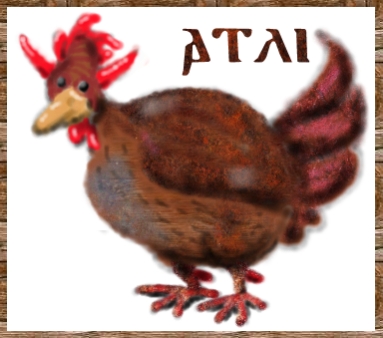 Sign of the Atli shops: "I am not a chicken, I am a Hun!" |
These shops are named Atli. The Hun on their sign is called Atli as well. It is one of the best known signs in Daleth. Many people in Daleth know the Hun only from the sign and from their plate. However, the artist who has drawn Atli never had seen a living Hun either, he only knew the ones served on plates in the salons of the upper classes - where they are served without the head. The head on the picture is based on rumours, stories and free imagination.
Related topics: