Skaunsric
and the Ruisende Bossen
As the Poorters started their war against the Naglani, many Naglani were killed. Those who survived fled to De Taycha or into the Ruisende Bossen (the wild forest of Skaunsric), the centre of Skaunsric. They left Isauls, Uzda and Elfane to the Poorters. Skaunsbrun, near the source of the Iven River, became the new capital of Skaunsric, the isolated community of the Naglani in Salamandran.
The deep forest of Skaunsric is a light, bright forest. The trees stand far apart, and both the leafs as the skin of the common trees are of a light colour. The trees that gave the forest its name are the Swumaesp, high poplar-like trees that make a rustling sound even in the slightest breeze. Other trees are the Abilra, the Lindaz, the Barks and the wide Isauls Oak. Between the trees grow bushes, like the Holutz, which is famous for its berries that make an excellent tea. Ferns and bracken are seen a lot on the humid ground, that is full of dead leafs and rotting, mildew-covered fallen off branches and toppled over trees, and furthermore the bottom of the forest is mazed with rippling, murmuring brooks of crystal clear rain water. The glades are covered with tough grasses, tender herbs and soft, humid moss.
In this soggy forest live a range of wild animals, birds (Setkaka, Achaks, Sabarv, Lerga) and fishes (Varl, Lox).
The borders of the Ruisende Bossen are somewhat cultivated by farmers and innkeepers. The forest is light there with nice glades and low hills, a popular place for picnics. The dukes of Hveitsvar and (Nieuw-) Gamoor with the upper class of the region organise large hunting parties in the forest, including late night drinks, and entertainment. There is more than enough wildlife in the forest for every one. The wildlife includes swine, rabbits, foxes, deer, wild sheep. There is also plenty of plants and mushrooms for the inhabitants of this region. Therefore, the people in the Is Valley and Skaunsric never new hunger - there was always the forest to turn to.
There are some runaways in the forest that hide themselves from the law. Most of them roam the parts of the forest that are still close to the populated areas, so they have easy access to the cultivated world - and can steal and rob and commit burglary. Most of them live in abandoned hunting huts and shelters, and in old foresters houses.
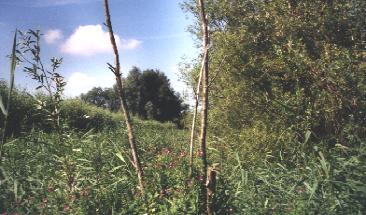
The Forest, near the Iven River
Old Isauls Road
The road between Isauls and Skaunsbrun is called the Old Isauls Road. Only the part from the border of the forest, where the “Bider Stadrand Inn” is, to the city of Isauls is still in use - but called the “Old Skaunsbrun Road”. The road is at parts still accessible and forms a track through the wild forest, the only real road in Skaunsric.It used to be the Thyngfyrst hunting road, the road which lead from the palace in Isauls to the hunting shed in the place that was later known as Skaunsbrun. Along the road are signs and mark stones, wells and shelters, now all ruined, but some still usable.
The Naglani of the forest still use this road to reach the rest of the world, and they know the exact tracks. But then, the people of the forest will also know the narrowest, most hidden paths of their territory.
“Ten Bosch” and “Bider Stadrand”
Two taverns, right outside the town, are worth mentioning. They were the hunting lodges of the noblemen in earlier years, but now they are the centre of upper class leisure and a place for excursions for all others.“Bider Stadrand” is just south of Isauls. You can see it from the southern door, situated in a green tranquil valley, where the Old Isauls Road comes from the forest. They serve an excellent Holutz tea and traditional Naglani dishes with ingredients fresh from the wood. A terrace is opened all year, with a view on the forest, and shaded by four Isauls Oak that have been there for centuries and are the only for that are left from the expanded oaktree forest of which the city Isauls is build.
“Bider Stadrand” has a six rooms for guests, at 10 Assar a night.
The other tavern worth mentioning is the “Ten Bosch”, just west of Samapol.
Also originating from a hunting lodge, this tavern still stand to its roots and the innkeeper organises hunts in the forest throughout the year. At the end of the day, the self killed animals can be grilled above one of the fireplaces that surround the tavern. The tavern provides the seats and tables, bread, and casks of the finest wine and beer.
“Ten Bosch” has rooms to let in the forest - small lodges with four beds each for only 2 Skilliggs per night (extra services not included).
Arkinaz
The largest settlement in Skaunsric is Skaunsbrun. But there is another settlement, of legendary status: Arkinaz. Now one has confirmed this place really does exist, but there are tales enough to make up a mental picture of this settlement deep into the wild forest.The place is build by the Naglani who fled from Elfane during the pirate raids. The whole town is made of wood and other materials found in the forest. Lore of dubious kind has it that the town is build in the treetops without any stairs or ladders, others say that is ridiculous - although the lore also mentions the flying capabilities of the Naglani and the easy access they would have to treetops.
| High up, high up above the trees Is the place where the Naglan flees Free of raids and free of chains Free of war thus free of pains Arkinaz the free tree top town Is where the thyngfyrst lost his crown (children's song from Isauls, the “thyngfyrst” who lost his crown is the last child in row that is being pointed to as the word crown is sung. He “is not it” and should leave the row.) |
Gräins Tree Yard
Halfway Uzda and Isauls, a narrow path leads into the forest. Wrinkly and hardly visible, the path goes deeper and deeper into the rustling forest. It is quite a walk to the end of the path, and it is impossible to access the forest here by carriage. But what is at the end, make it worth the trip.On a wide glade, a wooden house is build, surrounded by small huts that provide the slightest shelter to rain and cold. Nearby is a temple to Gräins, but actually, the whole glade is a temple to Gräins. More than that, the priest who has build this place, Nyster “The Treehugger” of Hveitsvar, claims the wood cures all kinds of diseases (mostly mental illnesses) with the help of Gräins.
Those who come here and seek the help of the Goddess, are asked a few questions to find out what kind of tree vibrates the same energy as the patient. As soon the tree type is determinated, the patient is placed in one of the huts, that is apparently build of wood from than particular tree. A sofa and a blanket are ready for the patient. The priest will hand out bread and water or tea every now and then, along with fruit and nuts - again from the chosen tree type. The patient can rest and pray, or take a stroll or eventually start a conversation with the tree that mirrors his own personality.
After a menoth, the patient can return home, cured and all. Many of them will carry a piece of the appropriate wood home, to help protect them against the evil influences that may have caused the disease.
Related topics: