In Daleth the markets provides places to sell goods for a paid for amount of time to everyone who wants to sell something. Some marketplaces are permanent rented by a marketeer; in such cases the difference between a market stall and a shop is not big.
Market Law
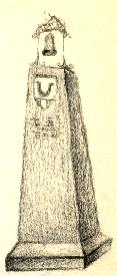 A Marketbell |
The entrance to the market is free for everyone. The stalls can be rented from the market master, but will not be for free. It is illegal to sell goods outside shops, foors or markets.
It is prohibited to carry weapons in the market, unless they are packed into a parcel.
A twentieth part of the profit of a marketeer is taken as market tax by the market master.
The market must be marked with a pillar or large stone, containing the coat of arms of the owner of the market, and the word "market" on it. In the city's administration must be made clear where and when the market begins and ends. The spatial end of the market must be marked in the pavement of the street or with fences. The beginning and ending of market time must be marked with a sound, that should be heard all over the market. A bell might have this function, but it might be needed that the sound is amplified with a soundwall, partly surrounding the bell.
Sorts
StreetmarketThe simplest market is the street market: a part of a street or a square that is on some days used as a market. The marketeers take their own stalls or carts or whatever they need to sell their products from or in. Some cars are especially designed to trade from.
A streetmarket is also seen near the market buildings in many places.
Courtmarket
The open courts between buildings used to be a popular place for streetmarkets. The buildings surrounding the court usually developed in a courtmarket, providing shops and warehouses for the marketeers.
Market building
The market building is usually a simple design by an unknown architect. It might have been inspired by the courtmarket, because it is the same with the only difference that the court has a roof over it.
There is a large hall for stalls (the court), and surrounding this are smaller places, in most cases a kind of niches, for rent. Some of these market buildings come with an ice cellar for common use. The market master has his home and office in the building. There are facilities as toilets, storage rooms, a water pump and such in the building. Outside the market building is -in most towns- a streetmarket. Of course, the rent for a stall in the market building is more expensive as the rent for a place in the streetmarket.
Supermarket
The supermarket is a large building, where the market is inside, completely indoors. There are doors to enter the supermarket, so it is good shopping there at all seasons.
Stock exchange
On the Dalethian stock exchange, the stock is sold. Basically, traders who have a warehouse full of goods, sell these goods to other traders without moving the goods. In order to show what exactly is sold (quality), some samples of the goods or products are shown in the stock exchange.
The warehouses can be rented from the master of the stock exchange, or are owned by one of the traders, who can ask rent for it, but usually doesn't because he can make enough money with trading alone.
The stock exchange needs a good administration of buyers and sellers, and the prices of the goods. A large team of market masters manages this. They have lists of complaints too, so no one can sell "vapour ware": stock that doesn't exist. To have a good name among the traders and the market masters is very important, and sometimes, names are sold too: when a trader stops working, he might sell the name of his office (and usually the office and the employers are in the deal too).
Market halls
The market halls are not consumer markets, but very large markets where traders buy their goods and produce to sell them later in shops or markets, or to use it in a factory to make other goods. Usually, carts full are driven into the markethalls and the carts bring the goods to the house of the buyer. Cart loads are a usual amount of goods here.
Near the coast, the market hall might be build next to the water to allow the fish trade to enter with boats into the market place.
The market halls have a market master and function basically the same way as other markets - just the amounts and the size are different.
Shops
All selling points that are not on the market are rated as shops and are supposed to be indoors or on a private court. Everybody is allowed to sell things from his own home or garden. Selling on the street is not allowed when not at a market. The big difference between shop and market are the times of opening: on the market, it is the market master who decides, in the shop, it is the shopkeeper. Shopkeepers don't have to pay market-tax and are themselves responsible for everything that happens in the shop.
Foor
The Foor is a temporary market that takes place once a year (in some larger towns more than once). The rules for a foor are not different from that of other markets, but many towns do have special adjustments for the foor: it is then allowed to be open late at night, for example, or the paths between the stalls have to be wider.
Related topics: