Koningsbord is commonly played with a square board, divided in 11x11 small squares. On the corners of the board are “doors” (painted, sometimes small doors or portals), and the middle square is a “tower” or “throne”. Coloured lines make regions on the board.
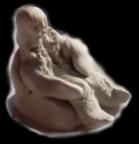 An antique King-piece, found near Hufa |
The object of the game for the attacker is to capture the king (see below). For the player with the king, the object of the game is to let the king escape through one of the doors. This happens when the king reaches one of the four corner squares.
The attacking player starts the game by moving one of the pieces in any but diagonal direction. A piece going over a line has to stop the move on the square directly on the other side of the line (it is impossible to move pieces from one side of the board to another). Only the king may be placed or moved/hop over the middle square. Hopping over other pieces is not allowed.
Pieces can be captured if they are placed between two pieces of the opponent. If a piece is moved between two pieces of an opponent, it doesn’t count as a capture. The edges of the square also count as “an opponent”, but the corner squares don’t. The king is captured in the same way, but there have to be at least three attacking pieces. Captured pieces are taken from the board.
After the first player made his/her move, it is the turn of the other player. All pieces move in the same way, including the king.
To make the game more easy, some rules might be changed before the game starts. For example, kids play the game without the coloured lines.
(This game is based on Hneftafl/Tablut and other ancient European chess-like games).
Related topics: