The Awéthi! game is a game played by the Naglani in the long winter nights of De Taycha. The theme of the game is their daily life in summer: herding their animals (aiwe) and protect them against the hungry wairgka (a kind of wolf).
The normal game consists of a large board of 25 x 25 squares, 4x4 awéthi (shepherds), 4 wairgk, and 4x6 aiwe. Each herd of 6 aiwe has 3 calves, 2 cows and 1 bull. There are multiple dice: 1 four-sided that is used for directions, 1 four-sided to indicate the movement of the awéthi, and 1 six-sides to indicate the movement of the wairgka.
There need to be at least two players: a awéthi and a wairgka. With more players, there are more awéthi. Most boards allow up to five players (four awéthi and one wairgka).
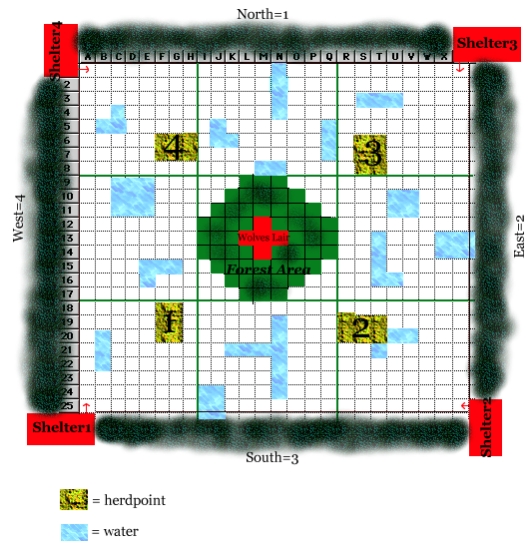
The game board
Game start
The game starts with
1. All wairgka in the “Lair” in the centre of the board. There are as much wairgka as awéthi.
2. For each player: his awéthi in one shelter on a corner of the board. With two players, the shelters used should be diagonally arranged.
3. For each player: his aiwe on the herding-point that is closes to the shelter. Each animal has one square of the board. The aiwe should be upside-down, and placed “blind” so no one knows on forehand which animal is where.
It is decided which player starts the game. The wairgka-player can never start the game. Only when one of the pieces enters the Forest, the wairgka come into action. The turns are as following:
1. The herd of player 1
2. The awéthi of player 1
3. The wairgk after the herd of player 1 (if he is already in the game)
4. The herd of player 2
... and so on.
The first turn starts with putting all aiwe right-side up, so it is visible if the piece is a calf, cow or bull.
General rule: one must use the full amount of squares as indicated with the dice.
Turn of the aiwe
Then the four-sided direction-die is rolled.
1 = north or northwest
2 = east or northeast
3 = south or southeast
4 = west or southwest
These directions are also written on the board. If the die shows a “3” for example, the animals in the herd move as following:
1. Each calf moves 1 square to the south
2. Each cow moves 2 squares diagonally to the southeast
3. The bull moves 2 squares to the south
However:
1. The aiwe cannot jump over water, nor can they end their turn in the water
2. The aiwe cannot enter the Lair
3. The aiwe cannot leave the board
4. The aiwe cannot end on an already occupied square
If an aiwe should end on any of those squares, it is set upon the square adjoining the target of the turn. That is, the last free square available before reaching the target.
The other players are allowed to move the herd as well, as long as it is according to the rules.
The turn of the awéthi
Once the herd has moved, the first awéthis enters the game. Four four-sided dice are rolled. The player is to decide whether:
a. Each awéthi moves the amount of eyes on one single die (a die for each awéthi) or
b. The sum of all dice is divided by four and all awéthi move the same amount of squares.
The awéthi are free to move in each direction, but not diagonally (or: to move one square diagonally, two eyes from the die are used: one to move straight ahead, and one to move to the left or right).
However:
1. Awéthi must end their turn on a free square
2. The awéthi cannot jump over other pieces on the board
3. The awéthi cannot leave the board
4. The awéthi are not allowed in the Lair
5. The awéthi may end its turn in the water, but must move out of it the very next turn.
If an awéthi cannot reach its target, it has to stay where it is, or move back to the shelter.
The turn of the Wairgk
As soon as one of the other pieces has entered the forest in the middle of the board, the wairgka are unleashed. The wairgk-player will be the next to play (after the awéthi-player has finished his turn). All wairgka start from the square in the middle of the board.
The four-sided direction-die is rolled:
1 = north
2 = east
3 = south
4 = west
The outcome means that the wairgk has to end its turn at least one square in the indicated direction from where it leaves the turn. The wairgk is free to move the amount of squares as indicated by a six-sided die. The wairgk can move in circles if necessary, as long as it has moved at least one square in the given direction at the end of the turn.
Only one wairgk can be moved at a time, the next turn for the wairgka is after the next awéthi-player has finished its turn.
However:
1. The wairgka cannot end its turn in the water
2. The wairgka cannot leave the board
3. The wairgka cannot end its turn on a square next to a square with a awéthi on it, with the exception of a square that has an aiwe on it (the hunger for aiwe is bigger than the fear of Naglani).
4. The wairgka is free to move in and out of the Lair
5. The wairgka can jump over aiwe , but not over awéthis, nor over water
Goals of the game
The aiwe have no goal, they just do what the dice tell them to do.
The goal of the awéthi is to “catch” the aiwe. They can do this by moving at least three awéthi around an aiwe. A diagonal square does not count for a catch. The aiwe is really caught after the turn of the herd. Thus:
1. The awéthis turn brings at least three awéthi on the surrounding squares of the aiwe.
2. The wairgk does not eat the caught aiwe in its turn
3. The caught aiwe cannot move during the turn of the aiwe
When it is the turn of the awéthi again, and the aiwe is still “caught”, the aiwe is removed from the board and placed in the shelter at the corner of the board. Then, the awéthis turn truly starts with rolling the dice.

A catch

No catch
The rule of “at least three awéthi” applies also when not all awéthi are played by the same person, thus, team-work is possible.
The goal of the wairgk is to eat as many aiwe as possible. A wairgk eats an aiwe when its turn end on the square an aiwe is already on. The player of the wairgka can decide to move all wairgka after the herd of one player, or to send each wairgk after another herd.
The eaten aiwe end up in the Lair (or at the side of the board, in front of the wairgk-player).
End of the game
The game ends when one of the players has no longer a herd to move. The aiwe are either in the shelter or in the tummies of the wairgka. If the player has three aiwe in the shelter, it’s a draw, are there only one or two aiwe in the shelter the wairgka have won from this player. The awéthi who has the most aiwe in the shelter wins the game. The wairgka only win if none of the awéthi have three or more aiwe in the shelter.
NB: the role of the wairgka is not to win, but to keep the players from winning! When awéthi is played for money, the wairgka player is kept out of the bets.
Advanced players work with points, the player with the most points wins the game:
a calf = 1 point
a cow = 3 points
a bull = 5 points
Some notes on the game
The game boards are made out of wood, cloth or leather, sometimes they are drawn on the sandy floor of the Naglani-houses. Each family has its own board, some of the boards are beautifully made, with realistically drawn trees and lakes on it and a lot of other decorations.
The game-pieces are made of clay, wood, ivory, or bone. They can also be true artwork, but many children play with simple symbols: the awéthi with a long stick in one hand, the wairgk with wide open yawsand a small tail. The aiwe are usually rectangular or round pieces engraved with symbols on one side (to indicate calf, cow or bull). Some of the more expensive games have miniature aiwe to replace the rounds or rectangular when the game has started.
The places of the lakes and rivers on the board may vary per game. As a rule, each ‘district’ should have an equal amount of water-squares. There are in that sense two kinds of districts, those next to the shelter and those between the shelter-districts. The forest does not have water as an unwritten rule.
Many games are sold in Daleth in a big box. The board may also be the top of a table, and the pieces are placed in drawers under it. Cardboard games with the board printed on it, with cut-out pieces, are also sold (for a few kintus) to those who love to play but cannot afford something more expensive.
Related topics: